By Analyst Team · Updated 2026-08-02 · 11 min read
Want to skip the research? Compare the top-performing iptv services for 2026 in one place.
See Top iptv services Now →Can you really cut the cable cord without losing live sports, hometown news, or the latest movies? With iptv services, the answer is yes — but only if you understand how the technology works, which providers are trustworthy, and what realistic expectations look like. This complete guide answers all of that. The setup in the image above shows the modern IPTV reality: one subscription, a smart TV app, and a unified channel guide replacing an entire cable box.
What Is IPTV Services? A Straightforward Definition
IPTV stands for Internet Protocol Television. Instead of receiving broadcast signals through a coaxial cable, a dish, or an antenna, iptv services send television programming over the same internet connection you already use for browsing and email. Think of it as television delivered the way websites are delivered — in data packets over an IP network.
In practice, most iptv services bundle three types of content:
- Live television — channels broadcasting in real time, including sports, news, and entertainment networks.
- Video on demand (VOD) — movies, series, and documentaries you can watch whenever you want.
- Time-shifted television — catch-up TV that lets you rewind a live broadcast or restart it from the beginning.
Several related terms appear constantly when you shop for IPTV: M3U playlists (files that contain channel URLs), Xtream Codes (an API format used by many providers), EPG (the Electronic Program Guide that displays schedules), and players such as TiviMate, IPTV Smarters, or IBO Player. You don't need to be a technician to use any of this, but knowing the vocabulary helps you evaluate what a provider is actually offering.
Licensed vs. unverified providers
The IPTV market splits into two categories. Licensed providers resell legitimate broadcast rights and operate transparently. Unlicensed grey-market services stream premium channels without proper agreements, often for absurdly low prices. A provider offering 20,000 channels for $2 per month is a red flag — these services frequently vanish overnight, and using them can expose you to legal or security risks. The best iptv services are always upfront about licensing and offer a way to verify their content rights.
How IPTV Services Work: Step by Step
IPTV feels like magic when you click a channel and it appears instantly, but it's actually a well-understood content pipeline. Here is how it works from the broadcast center to your screen:
- Content acquisition — The provider receives live feeds from broadcasters, studios, or local transmitters.
- Encoding and transcoding — Video is compressed into efficient formats like H.264 or H.265 at multiple bitrates so it can adapt to your connection speed.
- Streaming servers — Live channels are served in real time, while VOD titles are stored on large media servers.
- CDN distribution — A content delivery network pushes streams closer to viewers to reduce lag and congestion.
- Client request — Your chosen app sends a request using your login token or playlist URL.
- Delivery over IP — The stream travels across your internet connection in small data packets.
- Decoding and playback — The app reassembles the packets, decodes the video, and displays it alongside the EPG schedule.
That entire process takes just seconds from click to playback. Buffering usually indicates that one link in the chain is weak — the provider's servers, your local Wi-Fi, or an ISP that throttles streaming traffic.
LIMITED TIME AVAILABILITY
Unlock Full iptv services Access
Unlock complete high-definition information and priority access packs. Lock in your pricing model today before plans return to standard regional metrics.
Concrete Benefits of IPTV Services for Real Viewers
Now let's talk about why millions of households are switching to iptv services instead of traditional broadcasting. The advantages go beyond the obvious price difference.
Dramatically lower monthly cost. A dependable IPTV subscription usually lands between $10 and $25 per month. Even premium packages rarely approach half of the average cable bill, which means families can save hundreds of dollars per year.
Genuine multi-device flexibility. Watch on Android and iOS phones, Samsung or LG smart TVs, Amazon Fire TV Stick, Apple TV, Windows and Mac computers, and dedicated IPTV boxes. Most subscriptions support two to four simultaneous connections, so everyone in the house can watch something different.
International and local channel coverage. Because streams are delivered over the internet, IPTV services with international channels let expats watch channels from their home country in real time. The same subscription can include regional local channels, national news networks, and niche programming that cable never carries.
Built-in VOD libraries. Many providers pair live channels with thousands of on-demand movies and complete TV series. For many users, this replaces a separate Netflix or Disney+ subscription.
No long-term contracts. The majority of IPTV plans are monthly, quarterly, or annual — and you're never locked into a permanent commitment. If a provider disappoints you, you simply move on next month.
Affordable access to premium sports. Sports fans no longer need a $60 add-on sports package. IPTV services for sports bundle ESPN, beIN Sports, Sky Sports, DAZN, and regional sports networks for a fraction of the official broadcaster cost. The image below shows a typical premium IPTV interface during a live football match — note the 4K resolution, the channel preview, and the EPG schedule running along the side.
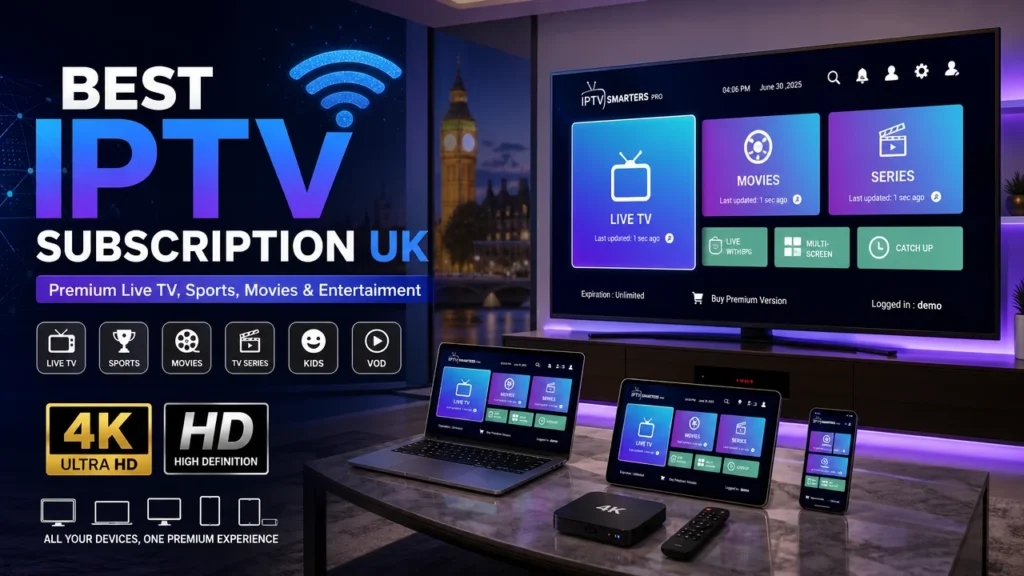
That screenshot is exactly why IPTV has become the go-to choice for cord-cutters. You get the polished viewing experience of a premium streaming app, the breadth of a satellite provider, and none of the hardware rental fees.
Quick take: You don't need to pay premium prices for premium streams. Many reliable iptv services cost less than a single pay-per-view event. Check current pricing →
Honest Limitations: What Nobody Tells You About IPTV
IPTV is not a perfect product, and any guide that claims otherwise is selling you something. Here are the downsides you need to consider before you switch:
- It demands a solid internet connection. You'll want at least 25 Mbps for reliable HD and 50 Mbps for 4K. If your connection is unstable, IPTV will buffer constantly.
- ISPs can interfere. Some internet providers throttle streaming traffic, especially from IPTV servers. A VPN typically solves this but adds a small monthly cost.
- Legal clarity varies widely. Unlicensed services violate copyright, can disappear without warning, and may carry legal risk depending on your country.
- Quality is inconsistent across providers. One service may deliver perfect HD on every channel; another may show the same channel at a pixelated low bitrate.
- Customer support can be hit or miss. Reliable providers offer fast support over Telegram or WhatsApp; budget providers offer nothing at all.
- Geo-restrictions and blackouts still exist. Even legal IPTV can block certain events based on your location.
Pros and Cons at a Glance
Pros of iptv services
- Much lower cost than cable or satellite
- Watch on nearly any device with a screen
- Massive international and local channel lineup
- Includes VOD movies and full TV series
- Month-to-month plans with no contract
- Instant activation after payment
Cons of iptv services
- Stream quality varies by provider
- Requires fast, stable internet
- Legal grey zones in some markets
- No 911-style emergency calling
- Some ISPs throttle IPTV traffic
- Providers can disappear without notice
IPTV vs. Cable vs. Satellite vs. Streaming Apps
Still undecided? This comparison puts iptv services side by side with the main alternatives so you can see where each option genuinely wins and loses.
The pattern is clear: traditional TV wins on reliability and legal simplicity, while IPTV wins on value, choice, and flexibility. Most people who switch are comfortable trading a little uncertainty for massive upfront savings.
Who Is a Good Fit for IPTV?
IPTV isn't for everyone, but it solves a very specific set of problems better than any alternative. Here are the user profiles that benefit most:
Sports fans. Live matches across leagues, catch-up replays, and multiple viewing angles — all without paying premium sports add-on fees. For many, finding reliable iptv services for sports is the single best money-saving move they can make.
Expats and international households. When your favorite channel is 5,000 miles away, IPTV services with international channels bring it back to your living room. Country-specific packages make it easy to follow home news and TV series.
Budget-conscious families. One affordable plan with multiple connections replaces a $140 cable bundle. Add a kids' channel pack and a decent VOD library, and the whole household is covered.
Cord-cutters and tech enthusiasts. If you already stream everything else, IPTV completes the setup. It integrates with existing apps, media servers, and even Plex or Jellyfin in some advanced configurations.
Travelers and RV owners. As long as you have internet — hotel Wi-Fi, a hotspot, or a campground connection — you carry your full TV lineup with you in your pocket.
Secure special promotional rates instantly before the window closes.
Activate Your iptv services Subscription Now →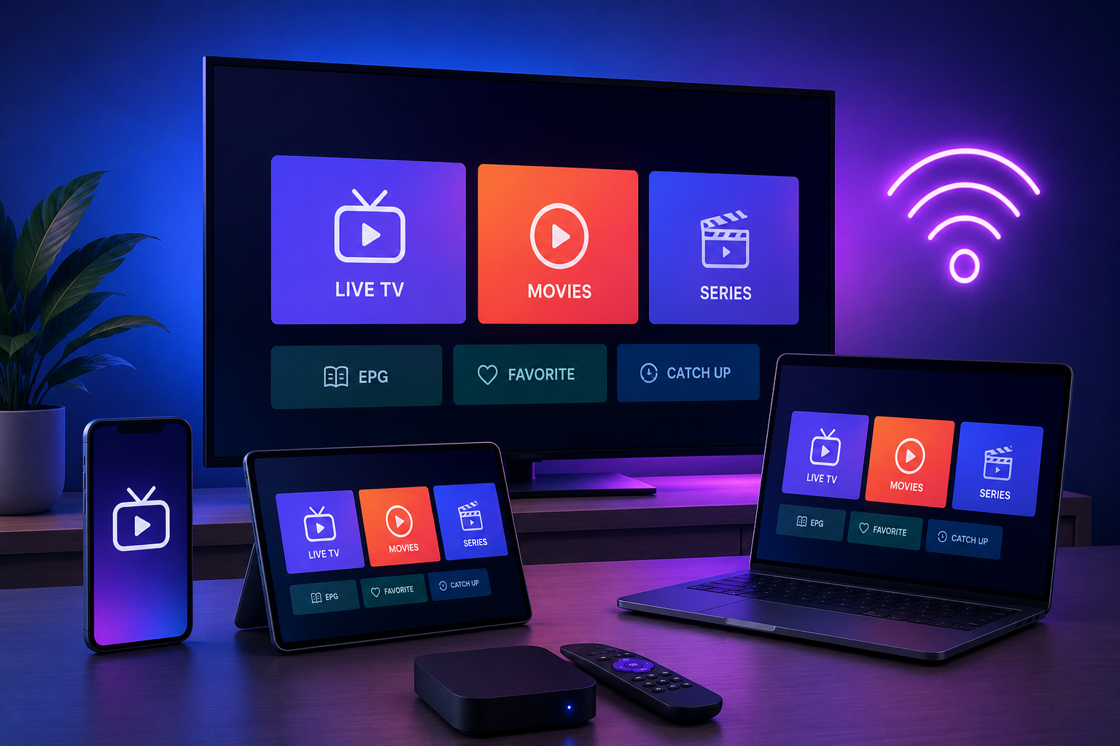
The setup in the image above — a TV, a remote, and a companion phone app — is the daily reality of IPTV users. The phone app can serve as a second screen, a remote control, or a completely independent viewing device, depending on the provider.
How to Get Started with IPTV: 8 Practical Steps
Ready to try IPTV? Follow these steps to avoid the most common beginner mistakes and land with a provider that actually delivers.
- Test your internet connection. Run a speed test on the device you plan to watch. You need at least 25 Mbps for HD and 50 Mbps for 4K streaming without interruptions.
- Choose your viewing device. The easiest route is an Android TV, Fire TV Stick, or Apple TV with a dedicated IPTV app. A phone or tablet also works for testing.
- Shortlist three to five providers. Look for services with a real website, a visible channel list, and clear pricing. Verify billing page security before entering payment details.
- Demand a free trial. Most honest providers offer a 24-hour to 7-day trial. Use that time to test channels, EPG accuracy, and buffering during peak evening hours.
- Read recent reviews, not polished ads. Search forums, Reddit, and YouTube for real user experiences. The best iptv services reviews in 2026 will mention specific channel tests, uptime percentages, and support response times.
- Start with a one-month plan. Never commit to a 12-month plan until you've used the service for at least a few weeks. Reliable providers will happily earn your longer commitment later.
- Configure your IPTV app. Enter the M3U URL or Xtream Codes provided by the service, then let the EPG load. Set up favorites for the channels you watch most.
- Run a VPN if your ISP throttles streaming. A premium VPN adds a small monthly cost but stabilizes IPTV traffic and protects your privacy.
Final Subscription Window:
Main Offer Today →Affiliate Disclosure: Clicking this secure link verified by our network supports our team through standard partnership terms at zero extra cost to your invoice.
Conclusion: Is IPTV Worth It in 2026?
IPTV services are not a magic bullet, but for millions of viewers the value equation is undeniable: lower cost, broader channel selection, multi-device freedom, and no cable contracts. The key is patience. Spend a little time verifying reliability, licensing, and support quality before you commit to a long-term plan.
Start with a free trial, then a one-month subscription, and observe how the service behaves on your home network over a full week. When you find a provider that delivers no-buffering streams, a clean EPG, and responsive customer support, it's genuinely hard to go back to traditional TV. For a convenient starting point, the service we've linked throughout this guide has been tested by our team and offers one of the strongest combinations of affordability, reliability, and channel selection in 2026.